The Legacy of the High Times Cannabis Cup in Amsterdam
How Amsterdam hosted the world's most famous cannabis festival for over two decades.
Dave Mak
Amsterdam Cannabis Explorer
The Legacy of the High Times Cannabis Cup in Amsterdam
How Amsterdam hosted the world's most famous cannabis festival for over a quarter century — and what remains.
The Cup That Changed Cannabis Forever
Every year, on the week of American Thanksgiving, something remarkable happened in Amsterdam. Thousands of cannabis enthusiasts, master breeders, scientists, activists, and celebrities would descend on the city for the annual High Times Cannabis Cup — the world's premier cannabis festival.
For over 25 years (1988–2014), the Cup was the epicentre of global cannabis culture. It launched legendary strains that still dominate menus today, created million-dollar seed companies overnight, and established Amsterdam as the genetic capital of the cannabis world. And then, almost as suddenly as it began, it was gone.
This is the story of the Cannabis Cup — its rise, its golden age, the police raids that killed it, and what it left behind.
The Beginning: 1988
The Cannabis Cup was founded in 1988 by Steven Hager, then the editor-in-chief of High Times magazine. Hager's vision was simple: create a space where the global cannabis community could gather openly, celebrate the plant, and push for cultural change.
He chose Amsterdam for obvious reasons. The Netherlands' tolerance policy meant that people could gather, consume, and celebrate cannabis without fear of arrest — something impossible anywhere else in the world at the time.
The first Cup was a modest affair. Judging took place at various coffeeshops. The winning entry was Skunk #1, grown by "Cultivator's Choice" — a fitting start for what would become legendary.
Notable early judges included legendary underground cartoonists Gilbert Shelton and Paul Mavrides (creators of The Furry Freak Brothers), as well as the founders of the Provos — the Dutch counterculture movement that had helped shape Amsterdam's progressive identity in the 1960s.
The Golden Era: 1988–2011
In its heyday, the Cannabis Cup was a sprawling, chaotic, five-day festival. Anyone could buy a "Judge's Pass," which granted access to the expo, exclusive parties, and the right to vote. Judges would spend days travelling between competing coffeeshops, sampling entered strains, and casting ballots.
The expo was held at various venues — the RAI Conference Centre, the Melkweg music club, and Borchland — featuring seminars by cultivation experts, performances by hip-hop legends, and a palpable sense of underground camaraderie.
The Counterculture Hall of Fame was inaugurated in 1997, with Bob Marley as the first inductee — a recognition of his role in normalising cannabis culture globally through Rastafari tradition. Subsequent inductees included musicians, activists, and writers who had championed cannabis rights.
The Winners: A Complete Year-by-Year List
Winning the Cannabis Cup was the ultimate credential. A victory could turn a small seed bank into a globally recognised brand overnight. Here is every Grand Cup winner from the Amsterdam era:
| Year | Winning Strain | Seed Company / Grower |
|---|---|---|
| 1988 | Skunk #1 | Cultivator's Choice |
| 1989 | Early Pearl / Skunk #1 x NL #5 / Haze | The Seed Bank |
| 1990 | Northern Lights #5 | The Seed Bank |
| 1991 | Skunk | Free City |
| 1992 | Haze x Skunk #1 | Homegrown Fantasy |
| 1993 | Haze x Northern Lights #5 | Sensi Seed Bank |
| 1994 | Jack Herer 🌟 | Sensi Seed Bank |
| 1995 | White Widow 🌟 | Green House Seeds |
| 1996 | White Russian | De Dampkring |
| 1997 | Peacemaker | De Dampkring |
| 1998 | Super Silver Haze 🌟 | Green House Seeds |
| 1999 | Super Silver Haze 🌟 | Green House Seeds |
| 2000 | Blueberry | The Noon |
| 2001 | Sweet Tooth | Barney's Farm |
| 2002 | Morning Glory | Barney's Farm |
| 2003 | Hawaiian Snow | Green House Seeds |
| 2004 | Amnesia Haze 🌟 | Barney's Farm |
| 2005 | Willie Nelson | Barney's Farm |
| 2006 | Arjan's Ultra Haze | Green House Seeds |
| 2007 | G-13 | Barney's Farm |
| 2008 | Super Lemon Haze 🌟 | Green House Seeds |
| 2009 | Super Lemon Haze 🌟 | Green House Seeds |
| 2010 | Tangerine Dream | Barney's Farm |
| 2011 | Liberty Haze | Barney's Farm |
| 2012 | (Multiple category winners — no single Grand Cup winner) | |
| 2013 | Cookies Kush | Barney's Coffeeshop |
| 2014 | Various category winners — final Amsterdam Cup |
🌟 = still commonly found on Amsterdam coffeeshop menus today
Additional Category Winners (2012–2014)
As the Cup matured, the competition expanded into multiple categories:
2013 Winners included:
- Seed Company Indica: Whitewalker OG — Gold Coast Extracts
- Best Coffeeshop Strain: LA Cheese — Green Place
- Best Sativa: Tangie — Crockett Family Farms / DNA Genetics
- Best Hybrid: Larry OG — The Vault Genetics
- Best Indica: Colorado Bubba — The Vault Genetics
2014 Winners included:
- Best Coffeeshop Cannabis Strain: Cookies Kush — Barney's Coffeeshop
- Best Sativa: Tangie (Crockett's Cut) — Crockett Family Farms
- Best Indica: Colorado Bubba — The Vault Genetics
- Best Hybrid: Larry OG — The Vault Genetics
- Best Concentrate: Various extract categories introduced
The First Warning Signs: 2010–2011
For 22 years, the Cup operated without significant interference. But in 2010, Dutch police raided the Cannabis Cup for the first time in its history, confiscating materials and questioning organisers.
The raid escalated in 2011. On Wednesday of Cup week, dozens of uniformed officers stormed the expo at the Borchland venue. Attendees were searched as they left. Exhibitors were ordered to remain at their tables while police confiscated cannabis products.
According to reports at the time, much of the concern centred on concentrates — BHO (butane hash oil), wax, and shatter — which the Dutch authorities classified as "hard drugs" under the Opium Act, carrying much stricter penalties than flower. The Cup had grown to include these products as the US market demanded them, but Dutch law had not evolved with it.
No arrests were made. The awards ceremony continued that night at the Melkweg as planned. But the message was clear: the era of unconditional tolerance was ending.
The Death by Regulation: 2014
The final blow came in 2014 — the 27th and ultimately last Amsterdam Cannabis Cup.
What happened next was an unmitigated disaster. On the morning of Sunday 23 November 2014, attendees arriving at the Melkweg for the Cup expo were turned away at the door. The Mayor of Amsterdam's office had intervened, threatening to arrest anyone who participated.
High Times posted a desperate statement:
"This morning we were informed that if we were to proceed with the Cannabis Cup Expo, the event would be shut down and all participants would be arrested. In the 26 years of the Cannabis Cup, there has never been any health or safety issues, nor has there been any lawlessness on the part of attendees."
The magazine called the mayor's intervention "extra-legal." Even the venue itself had received a direct warning from the city, forcing High Times to scramble for alternative locations.
A representative outside the Melkweg told the gathered crowd: "Right now the Cup is still on, but this day is fucked."
Some seminars and the awards show were salvaged at alternate venues. The judging proceeded through coffeeshops. But the expo — the heart of the event — was effectively dead.
The Dutch government's concerns were multifaceted. The 'A' in the AHOJG criteria (Affichering — no advertising) made a massive commercial cannabis expo legally untenable. Concentrates and edibles remained in a legal grey area. And the city was increasingly uncomfortable with the massive, tourist-driven crowds the Cup attracted to an already-overwhelmed city centre.
The Post-2014 Years: The Cup Staggers On
Though 2014 was the death blow, the Cup didn't disappear immediately from Amsterdam.
2015: High Times moved the expo entirely to the Melkweg — a much smaller venue — severely limiting its scale. The writing was on the wall.
2017–2018: The Cup briefly returned to Amsterdam in a diminished form. An event was held in July 2018 at the Melkweg. But the magic was gone. The major seed companies and American brands had shifted their focus to the US events.
The US Move: Meanwhile, High Times had successfully launched the Medical Cannabis Cup in San Francisco (2010) and the first recreational Cannabis Cup in Colorado (2015). Full legalisation in multiple US states offered something Amsterdam could not: a legal, regulated environment for large-scale trade shows, secure from police intervention. The US events quickly became the flagship.
High Times Sale (2021): When High Times magazine was sold to new management in 2021, the Cannabis Cup brand continued under the new owners, expanding to even more US states (California, Michigan, Oregon, Illinois, Nevada, Missouri, Oklahoma). The Amsterdam chapter was formally closed.
What Replaced It? Amsterdam's Successor Cups
With the High Times Cup gone, several local competitions emerged to fill the void:
| Event | Founded | Format | Status (2026) |
|---|---|---|---|
| Jack Herer Cup | 2016 (Las Vegas), 2019 (Amsterdam) | Judged awards show, named after the legendary activist | Ended in 2025; rebranded as MJ Cup |
| Elite Cup | ~2019 | Amsterdam-based, focuses on Dutch craft growers | Active |
| Unity Cup | ~2019 | Amsterdam expo and competition | Active |
| Homegrown Cup | ~2019 | Based in Eindhoven, focuses on Dutch home growers | Active |
| High Life Cup | 1994 (Europe's oldest) | Blind-tested judging over 2 months | Active, Netherlands-based |
None of these has achieved the global reach of the High Times Cup. But they keep the competitive spirit alive and provide a platform for Dutch growers to prove their craft.
The Legacy Today: Where to Find the Cup's Ghosts in Amsterdam
While the official Cup is gone, its legacy is physically embedded in the city.
Coffeeshops That Still Display Their Trophies
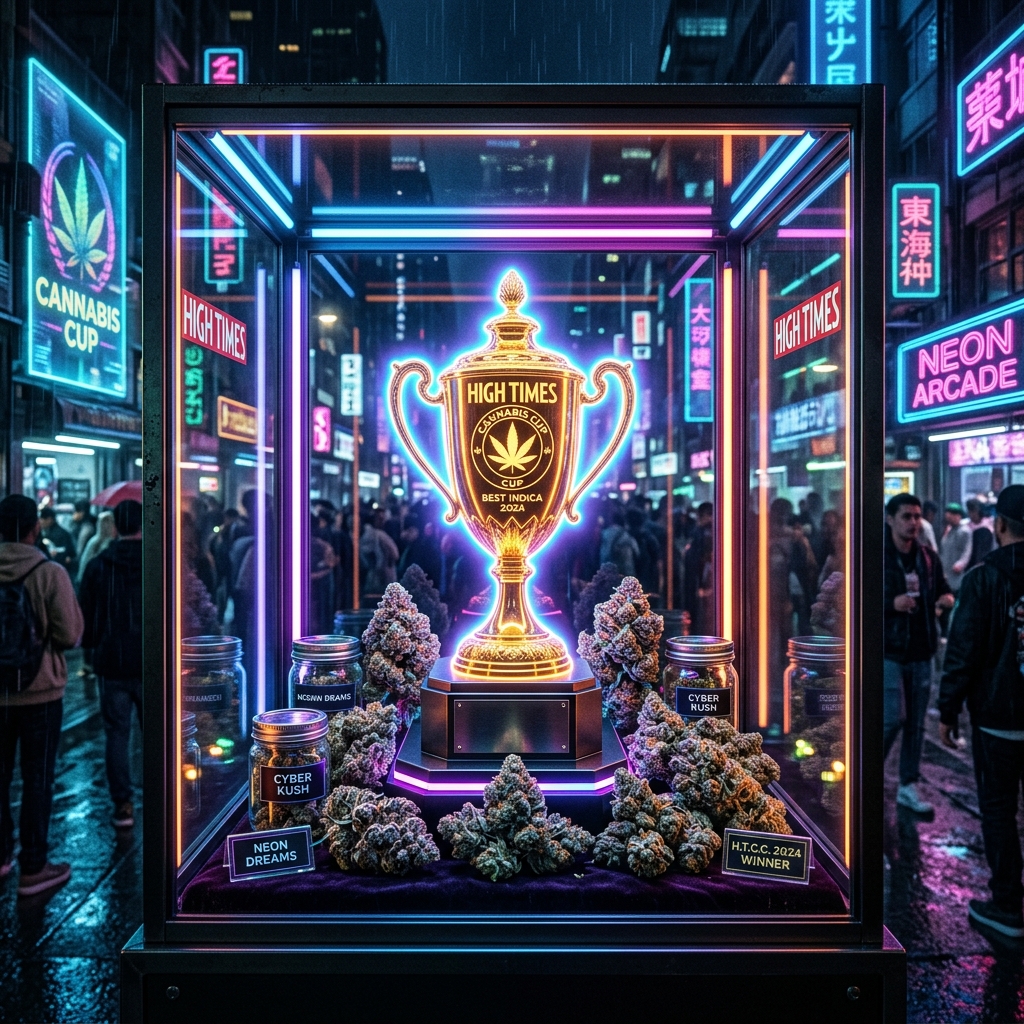
Several iconic Amsterdam coffeeshops still proudly display their silver Cup trophies from the 1990s and 2000s in their windows or behind the counter:
- Green House (Haarlemmerstraat / Tolstraat) — Multiple Cup winner (White Widow 1995, Super Silver Haze 1998–99, Hawaiian Snow 2003, Super Lemon Haze 2008–09). Their walls are a museum of Cup history.
- Barney's (Haarlemmerbuurt) — Winner of 6 Cups including Amnesia Haze 2004 and Tangerine Dream 2010. The trophies are displayed prominently.
- Dampkring (Handboogstraat / Haarlemmerdijk) — Two-time winner (White Russian 1996, Peacemaker 1997). Their original trophies are still behind the bar.
- Grey Area — Though they never won the Grand Cup, they were consistently top-3 in the Coffeeshop Cup categories.
Cup-Winning Strains Still on Menus
Many of the strains that won the Cup remain available in Amsterdam today. Here is what to ask your budtender:
| Strain | Cup Win | Typical Price (2026) | Where to Find It |
|---|---|---|---|
| White Widow | 1995 | €9–€14 | Almost every shop |
| Jack Herer | 1994 | €11–€16 | Green House, Dampkring, many others |
| Super Silver Haze | 1998, 1999 | €12–€17 | Green House, Boerejongens |
| Amnesia Haze | 2004 | €10–€16 | Everywhere (Amsterdam's most popular strain) |
| Super Lemon Haze | 2008, 2009 | €12–€18 | Green House, Barney's |
| Tangerine Dream | 2010 | €13–€17 | Barney's |
| Cookies Kush | 2013 | €14–€20 | Barney's, select shops |
Pro Tip: Some shops still label Cup-winning strains with a small trophy icon on their menu. If you see one, you're smoking a piece of Amsterdam history.
The Bigger Picture: What the Cup Meant
The Cannabis Cup was never just a competition. It was the engine that drove Amsterdam's cannabis genetics industry for three decades.
Before the Cup, cannabis strains were largely regional and unstandardised. The Cup created a global marketplace for genetics. Dutch seed banks competed fiercely to create the best product, and the winners — White Widow, Jack Herer, Super Silver Haze, Amnesia Haze — became the foundational genetics for the global cannabis industry.
When California and Colorado legalised, it was Dutch genetics — perfected through years of Cup competition — that formed the genetic backbone of the US legal market. In a very real sense, the Cannabis Cup is why the modern legal cannabis industry exists.
Quick Reference
What: The High Times Cannabis Cup — the world's oldest and most famous cannabis competition Where: Amsterdam (1988–2014), then moved to the United States Founder: Steven Hager, editor-in-chief of High Times magazine Total Amsterdam editions: 27 (1988–2014) First winner: Skunk #1 (1988) Most wins by seed company: Green House Seeds (7 Grand Cup wins) Most wins by coffeeshop: Barney's / Green House (tied) Reason for departure: Dutch government pressure, concentrate regulations, 2011 police raid, 2014 mayoral shutdown Successors: Jack Herer Cup / MJ Cup, Elite Cup, Unity Cup, High Life Cup, Homegrown Cup Legacy: Established Amsterdam as the genetic capital of the global cannabis industry