Big Menus vs Small Menus: What Coffeeshop Menu Size Really Means (2026)
A 70-strain menu looks impressive, but every Amsterdam coffeeshop is capped at 500g of stock. We crunched real menu data across 110 active Amsterdam shop menus to show why small menus actually sell out less.
Dave Mak
Amsterdam Cannabis Explorer
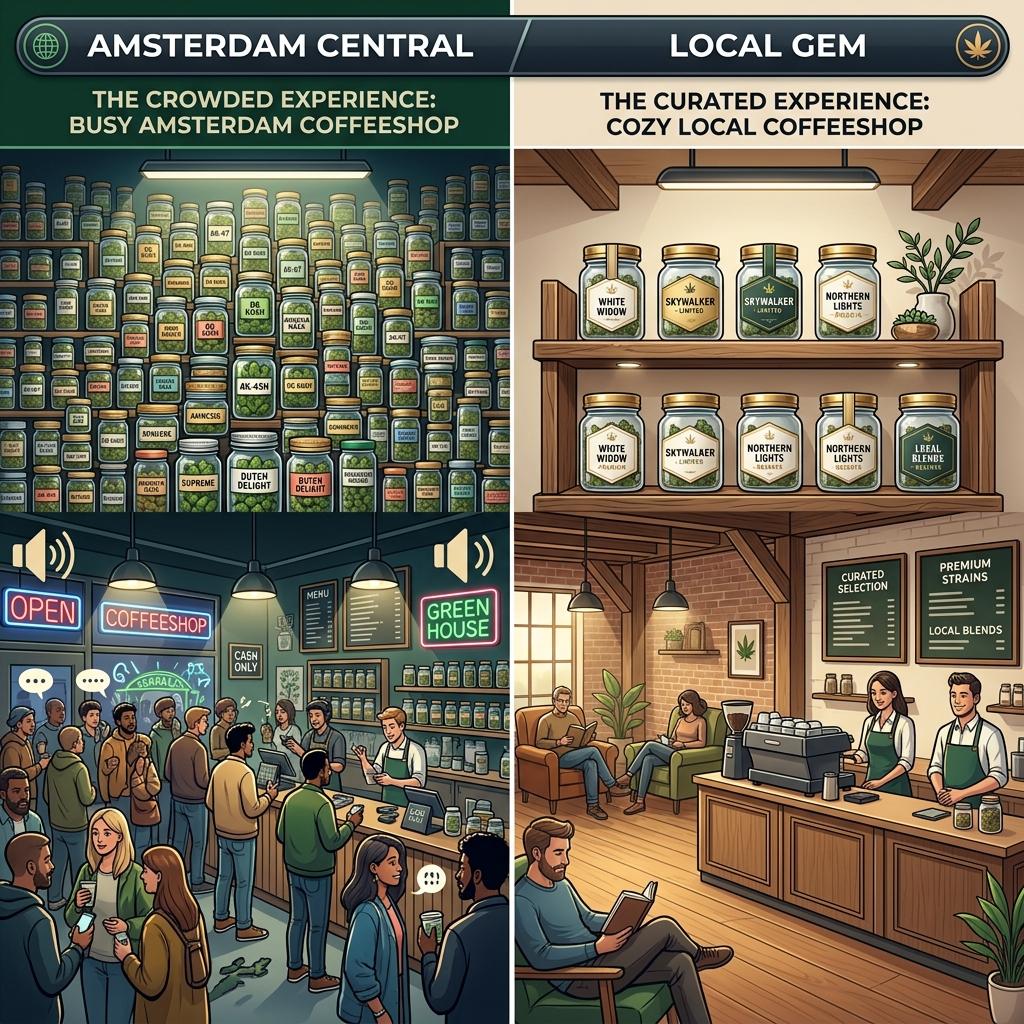
Walk into a tourist coffeeshop near the Red Light District and you'll see the wall of jars. Sixty names. Seventy names. Glamfruit, Zowahh, Gary Payton, Rainbow Zizi, some strain you've never heard of with a name like a modern art exhibit. It looks incredible. It looks like the shop has everything.
Walk into a proper neighborhood spot in De Pijp or Oost and you'll see maybe fifteen or twenty jars. Amnesia, Lemon Haze, White Widow, a couple of hashes, done.
Which one is the better shop?
Most tourists assume the big menu wins — more choice, more rare genetics, more to brag about back home. But there's a catch that almost nobody talks about, and it's the single most important thing to understand about how an Amsterdam coffeeshop actually runs: every coffeeshop in the city is legally capped at 500 grams of stock. Not 500 grams per strain. 500 grams total. Flower and hash combined.
So when a shop lists 70 strains, do the math on what that means for how much of each strain they actually have behind the counter. This guide uses real, dated menu data from across 110 actively tracked Amsterdam coffeeshop menus (out of the 144 active shops in the city) to break down the big-menu-vs-small-menu question — what you're really getting, what sells out, and which shop to pick depending on what you want.
The 500g Rule: The Invisible Ceiling on Every Menu
Every Amsterdam coffeeshop operates under the Dutch "gedoogbeleid" (tolerance policy). One of the core conditions (the "G" in the AHOJ-G criteria) caps the on-hand trade stock at 500 grams of cannabis products — flower and hash together. You can read the enforcement ladder yourself in official municipal policy: hold 500g–1kg over the limit and you get a warning first, then a 3-month closure, then a 6-month closure, then your license gets pulled.
On top of that, the 5-gram rule limits how much any single customer can buy per transaction.
Two more things worth knowing:
- The 500g cap is suspended inside the wietexperiment — the 10 Dutch municipalities trialling fully legal, tracked supply. Amsterdam is not one of them, so the 500g ceiling still applies to every shop on this site.
- In September 2025, coffeeshop owners in Leiden asked the city to double the cap to 1,000g, calling the current rule "impossible to work with." The limit genuinely bites.
So every shop you visit has, in theory, the same 500g of cannabis to spread across everything on its board.
The Math: What 500g ÷ Menu Size Actually Looks Like
Here's where the menu size question gets real. Let's divide that 500g across different menu sizes:
| Strains on menu | Average per strain | Real-world example |
|---|---|---|
| 70 | ~7.1g per strain | 7th Heaven (70 strains) |
| 53 | ~9.4g per strain | Siberie (53 strains) |
| 35 | ~14.2g per strain | Average mid-sized shop |
| 25 | ~20g per strain | The Amsterdam median |
| 17 | ~29.4g per strain | Papillon (17 strains) |
| 8 | ~62.5g per strain | The Otherside (8 strains) |
Now the kicker: a customer is legally allowed to buy 5 grams per transaction. At a 70-strain shop, one single customer buying the maximum is enough to clear nearly 70% of a strain's entire theoretical stock. At a 17-strain shop, that same customer takes just a fraction of a single strain's buffer.
The Golden Rule: A mega-menu doesn't mean a shop is full of weed — it means the weed they do have is spread razor-thin across dozens of jars.
Reality check: shops restock, the 500g is a legal ceiling not a daily target, and not every listed strain is sitting out for tasting. But the general relationship is unavoidable — the bigger the menu, the thinner the buffer on each line.
What the Real Data Shows: How Big Are Amsterdam's Menus, Actually?
There are 144 active coffeeshops in Amsterdam today. We pulled the latest dated menu from our sample of 110 active Amsterdam shop menus, counting only the actual weed and hash strains (not pre-rolls, edibles, or accessories). The picture is clear:
- Median menu: 25.5 strains. Half of all active Amsterdam coffeeshops carry 25 or fewer strains.
- Average menu: 28.0 strains.
- Most common range: 21–35 strains (55 of the 110 active menus).
Full distribution across 110 active Amsterdam shop menus:
| Menu size | Active Amsterdam Shops |
|---|---|
| 10 or fewer strains | 6 |
| 11–20 strains | 26 |
| 21–35 strains | 55 |
| 36–50 strains | 13 |
| 50+ strains | 10 |
Only 10 of 110 tracked active menus (around 9%) run a true mega-menu of 50+ strains. The 70-strain boards you see in some corners of the city are very much the exception, not the norm.
The biggest active menus in Amsterdam:
- 7th Heaven — 70 strains
- Loft — 62 strains
- JollyGood — 60 strains
- Old Church 2 — 59 strains
- Green Place 2 — 54 strains
- Mediterrane — 54 strains
- New Times — 53 strains
- Reefer — 53 strains
- Siberie — 53 strains
- Republiek — 51 strains
The smallest active menus in Amsterdam:
- Bluebird — 1 strain*
- Bij — 4 strains
- The Otherside — 8 strains
- Flower Power — 9 strains
- Jolly Joker — 10 strains
- 420 Cafe (de Kuil) — 10 strains
- New Amsterdam — 11 strains
- The Bulldog Rockshop — 11 strains
- Katsu — 12 strains
- Basjoe — 12 strains
(Note: Extremely small counts may reflect partial menu captures or specialty focus rather than total inventory).
The Sell-Out Proof: Menus That Constantly Turn Over
When we compare a shop's menu against its own older menu snapshots, we can measure turnover — how much of the menu changed between visits.
The big-menu shops don't just look different week to week. They almost completely recycle their strains within a couple of months:
- JollyGood — 154% menu turnover over 90 days.
- Loft — 115% turnover in 63 days.
- Siberie — 111% turnover in 43 days.
- 7th Heaven — 93% turnover in 55 days.
Meanwhile the small-to-medium menu shops remain stable:
- Papillon — just 9% turnover over 149 days. Five months later, ~91% of the same menu is still there.
- Cheech & Chong's 2 — 13% turnover over 237 days.
- Crush — 35% over 114 days.
That's the practical difference. A big menu is a churn — strains rotate in and out fast because each one only has a few grams to sell before it's gone. A small menu is a stock — the shop has committed to a handful of strains and keeps them reliably on the shelf.
The Case for Big Menus (Pro + Con)
Pros:
- Variety is real. Want to try a Cali import, a Z-kush, and a heritage haze in one sitting? A big menu offers that range under one roof.
- Rare finds. Mega-menus are where you'll discover strains that show up nowhere else.
- Strain-spotting. If you're chasing a specific strain name, a big menu is statistically more likely to list it.
- Price spread. Big menus usually run the full ladder from budget selection weed up to top-tier Cali tins.
Cons:
- Sell-outs are constant. Strains can sell out fast, and menu boards lag reality.
- Aspirational listing. A board showing 70 names doesn't mean 70 jars are full.
- Thin stock means older stock. With 60+ lines to move through, individual jars sit longer.
The Case for Small Menus (Pro + Con)
Pros:
- In-stock accuracy. A 17-strain shop lists what it actually has behind the counter.
- Fresher flower. Smaller numbers of lines turn over faster.
- Curation. The best small-menu shops use their compact board as a curation statement.
- Stability. The same strains remain available consistently over months.
Cons:
- Less variety. One visit offers fewer categories to choose from.
- Fewer exotics. Niche one-off drops rarely land on a 15-line menu.
Which Should You Pick? A Simple Decision Guide
Choose a big menu (40+ strains) when:
- You want broad variety across multiple categories in one visit.
- You're strain-hunting for rare names.
- You want to compare prices across a full ladder.
Choose a small menu (under 20 strains) when:
- You know what you like and want reliable stock.
- You care about freshness and consistent quality.
- You're buying in the evening, when big menus are often picked over.
Pro move: The 25-strain median is the sweet spot — enough variety to explore, with enough inventory depth that strains stay in stock.
Menu size data compiled from dated menu snapshots across 110 active Amsterdam coffeeshops (out of 144 active shops in total). Prices and menus change — check DamLive for live updates.
Find Hotels near Amsterdam Centrum
Find the best smoker-friendly hotels and boutique stays in the Amsterdam Centrum area.
Read Next
More guides from the Economics & Data category.

The Tourist Tax: The Real Economics of Amsterdam Coffeeshops
Amsterdam Weed Price Index 2026 | Monthly Market Tracker & Benchmark
%2C_juli_2012_-_panoramio.webp&w=3840&q=75)