
The Complete Cannabis Family Tree: How Every Product & Extract Is Made
From live resin and solventless rosin to Piatella, Frenchy Cannoli temple balls, and Moroccan static sift: the definitive who, where, when, what, and why guide to every cannabis extraction.
Dave Mak
Amsterdam Cannabis Explorer

The Anatomy of the High: The Trichome Factory
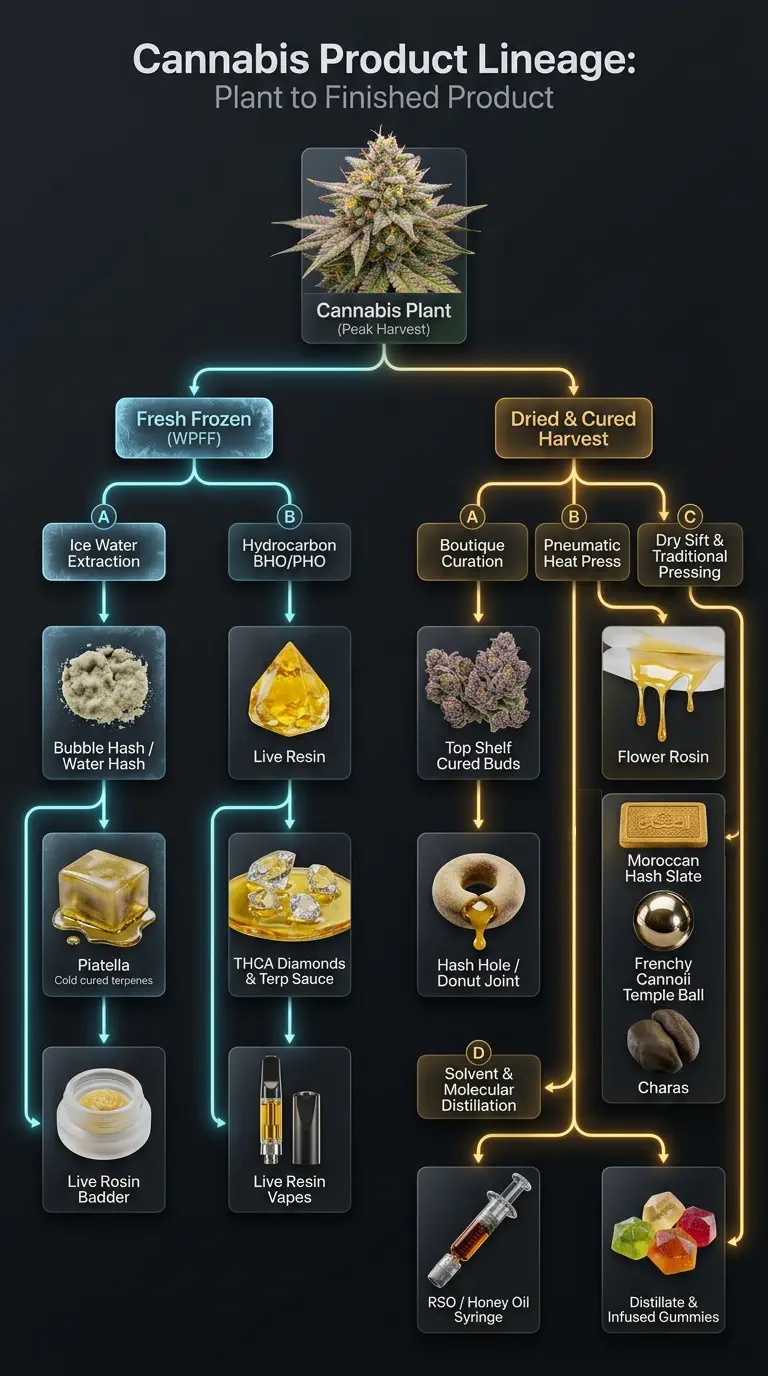
Whether you are staring at a multi-tiered dispensary menu in Los Angeles or an illuminated glass board in an Amsterdam coffeeshop, ordering modern cannabis can feel like walking into an advanced organic chemistry lab. The days of simply choosing between "green weed" or "brown hash" are officially over.
Today's menus are dominated by high-end terminology: Live Rosin, Piatella, THCA Diamonds, WPFF, Static Sift, Nug Smashing, and Temple Balls. How did we get from a wild green plant in the mountains to a translucent crystal boulder swimming in liquid terpene sauce?
Every single cannabis product in existence—from a €10 Moroccan blonde hash brick to a €120 jar of Spanish cold-cured water hash—traces back to a single microscopic structure: the capitate-stalked glandular trichome.
Trichomes are the crystal-like resin glands that coat female cannabis flowers. Their swollen, bulbous heads contain virtually all the medicinal and psychoactive treasures of the plant: cannabinoids (THC, CBD, CBG) and aromatic terpenes (myrcene, limonene, caryophyllene). Every processing method is simply a different engineering answer to the same question: How do we separate the resin glands from the plant cellulose, and how do we preserve or transform them?
Below is the definitive, step-by-step family tree of cannabis products, detailing the Who, Where, When, What, and Why behind every extraction and curing method known to modern counterculture.
The Great Fork: Fresh Frozen (Live) vs. Dried & Cured Biomass
At the exact moment of harvest, every cultivator and extractor faces an irreversible decision that splits the cannabis family tree in two:
- The "Live" Pathway (Fresh Frozen): Chop the living plant and immediately plunge the fresh, wet flowers into deep sub-zero temperatures (-20°C to -80°C). The buds never dry, cure, or oxidize.
- The "Cured" Pathway (Dried Biomass): Hang the whole plants upside down in a dark, climate-controlled room (15°C / 60% humidity) for 10 to 14 days, followed by weeks of jar curing.
This single fork determines whether your final product preserves the volatile, fruity mono-terpenes of a living garden, or the deeper, richer, spicy sesquiterpenes of cured vintage herb.
Branch 1: The Fresh Frozen "Live" Solventless Realm
In the solventless world, ice and water are not solvents—they are mechanical carriers. No chemical solvents like butane, propane, or alcohol ever touch the trichomes.
1. WPFF (Whole Plant Fresh Frozen)
- What: Whole female colas harvested at peak gland ripeness. Large fan leaves are gently stripped by hand, and the fresh, un-dried flowers are sealed in vacuum bags and flash-frozen within two hours of cutting.
- Who: Underground legacy hash makers in Oregon and California; popularized openly in medical forums by William "KindReviews" Fenger around 2011–2013.
- Where: The Pacific Northwest & Emerald Triangle (California), USA.
- When: Early 2010s.
- Why: When cannabis hangs to dry, up to 70% of its light, volatile mono-terpenes (such as fresh pinene, limonene, and myrcene) evaporate into the drying room. Freezing locks in the exact terpene profile of the living garden at harvest.
2. Ice Water Hash / Bubble Hash
- What: WPFF buds are immersed in a bath of purified reverse-osmosis water and crushed ice at 0°C to 4°C. Gentle vortex agitation causes the frozen trichome stalks to snap cleanly. The ice-water slurry drains through graduated nylon mesh bags (typically 220µ, 160µ, 120µ, 90µ, 73µ, and 25µ). The premium "full-melt" heads collect in the 73µ–120µ screens.
- Who: Invented by Mila Jansen ("The Hash Queen") in Amsterdam with the Pollinator and Ice-O-Lator (1998); perfected into multi-bag capture by Marcus "Bubbleman" Richardson (Bubble Bags).
- Where: Amsterdam, Netherlands and Vancouver, Canada.
- When: 1998–2002.
- Why: Completely non-toxic, food-grade, and mechanical. It isolates pristine trichome heads without a single drop of petrochemicals.
3. Piatella (Cold-Cured Full Melt Water Hash)
- What: The modern pinnacle of solventless hash making. Six-star full-melt ice water hash is freeze-dried, tightly wrapped in medical cellophane, and left to undergo an anaerobic cold-cure inside a refrigerator at 4°C to 10°C for weeks or months. Without any applied heat, the trichome membranes naturally undergo autolytic breakdown, transforming into an opaque, butter-soft cheese block that spontaneously sweats liquid terpene puddles.
- Who: Created and coined by Zio from Uncle's Farm Cannabis Social Club in Barcelona.
- Where: Barcelona, Catalonia, Spain.
- When: 2018–2020 (exploding globally across US and European markets by 2023).
- Why: Traditional rosin presses use heat (65°C–85°C) which inevitably burns off the lowest-boiling-point terpenes. Piatella preserves 100% of the cold-temperature aromatic spectrum, delivering a velvety dab that melts instantly at low temperatures. Read our dedicated Amsterdam Solventless & Piatella Guide for current coffeeshop pricing.
4. Live Rosin (Cold Cure Badder, Fresh Press & Jam)
- What: Freeze-dried fresh frozen bubble hash is packed into 25µ or 37µ mesh filter sleeves and placed between heated aluminum platens on a pneumatic or hydraulic rosin press. Under gentle heat (65°C–75°C) and pressure (500–1200 PSI), pure solventless resin bleeds out onto unbleached parchment paper.
- Fresh Press: Dabbed directly off the press—glassy, rigid, and translucent.
- Cold Cure Badder: Sealed in an airtight glass jar at room or cellar temperature and whipped into a creamy, opaque, shelf-stable batter.
- Rosin Jam / Solventless Diamonds: Warmed under sealed low heat (35°C–45°C) to induce THCA crystallization in a rich terpene soup.
- Who: Technique pioneered by Phil "Soilgrown" Salazar; refined into commercial ice-hash pressing by California labs like 710 Labs.
- Where: California and Colorado, USA.
- When: 2015 to present.
- Why: The premier connoisseur dab. It provides pure cultivar expression, high potency (70%–85% THC), and zero residual solvent risk.
Branch 2: The Fresh Frozen Hydrocarbon Realm (Solvent-Based)
5. Live Resin & Whipped Live Badder
- What: Fresh frozen biomass packed into chilled stainless-steel columns inside a closed-loop extraction system. Liquid butane and/or propane chilled to -40°C washes over the buds, dissolving cannabinoids and terpenes in seconds while leaving frozen water and plant lipids behind. The solvent is evaporated under vacuum and recaptured.
- Who: William "KindReviews" Fenger and equipment fabricator Giddyup.
- Where: Denver, Colorado, USA.
- When: 2011–2013.
- Why: Offers an intense blast of living terpene flavor at a fraction of the production labor required for water hash, making top-tier live concentrates accessible to the broader market.
6. THCA Diamonds & Terp Sauce (HTFSE / HCFSE)
- What: Unpurged live resin extract is placed into sealed mason jars or stainless-steel vessels under light pressure (the "Jar Tech" / "Diamond Mining" method). Over two to four weeks, heavy THCA molecules bind together and precipitate out of solution as faceted, translucent mineral-like gems (HCFSE - High Cannabinoid Full Spectrum Extract), resting in a golden syrup of pure aromatic liquid terpenes (HTFSE - High Terpene Full Spectrum Extract).
- Who: Underground California and Oregon hydrocarbon extractors.
- Where: Emerald Triangle & Central Coast, California, USA.
- When: 2015–2017.
- Why: Unrivaled visual appeal and astronomical potency. The THCA crystals often test at 97% to 99% pure cannabinoid content, allowing consumers to customize their exact ratio of pure potency to liquid flavor on their dab tool.
Branch 3: The Cured Flower & Craft Smoke Realm
7. Boutique Cured Flower ("Cali Packs")
- What: Whole colas hang-dried for 14 days and cured in climate-controlled glass jars or cure chambers. The chlorophyll breaks down smoothly, creating white ash and smooth, dense smoke.
- Who: Generations of legacy breeders; modern exotic genetics pioneered by California collectives (Sherbinskis, Cookies, Seed Junky, Alien Labs).
- Where: Worldwide; industrialized in California, USA.
- When: Ancient origins; refined into modern boutique packaging (mylar tins/jars) from 2016–2026.
- Why: Flower remains the emotional soul of cannabis. The tactile ritual of breaking up cured buds, rolling a joint, and experiencing the balanced synergy of intact plant material is irreplaceable. Learn more about how modern breeding reshaped flavors in our guide on Why Everything Tastes Like Gelato.
8. Hash Holes / "Donut Joints"
- What: An elite 2.0g to 3.5g joint rolled with premium ground flower, wrapped around a thin, perfectly centered 0.5g to 1.0g cylinder of live rosin or water hash. As the joint burns, the central rosin melts and vaporizes slower than the outer flower, leaving a clean, hollow open ring ("the donut") with a bubbling perimeter of golden oil.
- Who: Invented by Fidel Hydro (Fidel's Hash Holes) and popularized by artisan rolling outfits like Proper Doinks.
- Where: Los Angeles, California, USA.
- When: 2019–2022.
- Why: Eliminates the messy, uneven burn of traditional hash joints. The center airway draws cool air across the melting concentrate, delivering massive flavor and vapor volume without harshness.
9. Flower Rosin ("Nug Smashing")
- What: Dried, cured buds placed directly into a 90µ–120µ nylon filter mesh and crushed between heated hydraulic plates at 90°C to 105°C for 60 to 90 seconds. Thick, warm, amber sap squeezes out onto parchment.
- Who: DIY home growers following the early 2015 "hair straightener" hacks.
- Where: Garage setups and craft grows worldwide.
- When: 2015–2018.
- Why: Instant gratification. In under two minutes, any grower with cured bud can produce clean, solventless dab oil without needing ice bags, freeze dryers, or dangerous solvent tanks.
Branch 4: The Ancient & Sifted Artisan Realm
10. Dry Sift & Traditional Moroccan Hash
- What: Dried plants are shaken or beaten over silk or nylon screens stretched over bowls. The friction knocks loose the dry, brittle resin gland heads, collected as golden kief powder.
- Static Tech / Filtered: Contemporary European hash makers run static-charged cards across the powder to pull out 99% of plant debris.
- Hot Pressing: The sift is wrapped in cellophane and hydraulically pressed with light heat into dense, fragrant, stamped bricks (e.g., Ketama, Double Filtered, Beldia).
- Who: Berber farmers of North Africa; European connoisseur collectives like Drytech and Golden Farm.
- Where: The Rif Mountains (Chefchaouen, Ketama), Morocco.
- When: 1960s Hippie Trail era to the modern 2026 static revolution.
- Why: Unmatched shelf stability. Traditional hash can sit in a drawer for years without spoiling. It produces a rich, herbal, peppery smoke that pairs perfectly with black coffee. Explore historical menus in our Amsterdam Hash & Solventless Extracts Guide.
11. Frenchy Cannoli Temple Balls
- What: High-quality dry sift or bubble hash is wrapped in cellophane and kneaded across parchment using a heavy glass wine bottle filled with boiling water (100°C). The thermal energy decarboxylates the core and fuses the trichome skins into a shiny, molten paste. It is hand-rolled into a mirror-glossy sphere and aged in a cool, dark cellar for months or years.
- Who: Master hashishin Frenchy Cannoli.
- Where: Northern California, drawing on traditional techniques learned across India, Nepal, and Morocco.
- When: Perfected 1980s–2010s; popularized through public workshops until his passing in 2021.
- Why: Curing temple balls induces the formation of Hashishene, a unique terpene formed through the degradation of myrcene under heat and oxygen. The exterior forms a protective skin that seals in moisture and aromatics, developing smooth, wine-like vintage complexity.
12. Charas & Malana Cream (The Living Friction Harvest)
- What: The oldest form of concentrate on the planet. Harvesters walk into fields of wild or cultivated living cannabis plants just before sunrise. They rub the flowering colas vigorously between clean bare palms. Body warmth and friction rupture the resin heads, leaving a thick, black tar-like glaze on the hands, which is rolled off into sticks and balls.
- Who: Indigenous Himalayan villagers and Hindu sadhus.
- Where: Parvati Valley (Malana, Tosh, Kasol), Himachal Pradesh, India.
- When: Practiced continuously for thousands of years; documented in ancient Vedic scripture.
- Why: Zero equipment or infrastructure required. Charas captures the live essence of high-altitude Himalayan landraces, delivering a euphoric, spiritual, and deeply meditative psychedelic state.
Branch 5: The Molecular & Refined Realm
13. Rick Simpson Oil (RSO) & Full-Spectrum Ethanol Extracts
- What: Whole cured buds and trim soaked in high-proof alcohol, dissolving cannabinoids, waxes, and dark chlorophyll. The alcohol is boiled off completely, leaving a dark, viscous, tar-like oil packaged in oral dosing syringes.
- Who: Canadian engineer and medical activist Rick Simpson.
- Where: Nova Scotia, Canada.
- When: Early 2000s.
- Why: Purely therapeutic. RSO is harsh to smoke, but when consumed sublingually or eaten, it provides intense, long-lasting relief for chronic pain, severe insomnia, and chemotherapy-induced nausea.
14. Supercritical CO2 Honey Oil
- What: Biomass is placed in high-pressure chambers with compressed carbon dioxide entering a supercritical state (acting as both gas and liquid). It strips cannabinoids cleanly without leaving hazardous petroleum residuals.
- Who: Industrial pharmaceutical and botanical labs.
- Where: Colorado and California, USA.
- When: Mid-2010s.
- Why: Non-toxic, non-flammable, and food-safe, making it a staple for clean vape pens and medicinal tinctures.
15. Fractional THC Distillate & Pure Isolates
- What: Crude cannabis oil is winterized, decarbed, and fed through a short-path or wiped-film distillation still. Under high vacuum and exact boiling points (155°C–180°C), pure THC evaporates and condenses into a clear, golden, viscous honey testing at 90% to 98% pure Delta-9 THC. All native terpenes and minor cannabinoids are stripped away.
- Vape Cartridges: Distillate re-infused with steam-distilled cannabis terpenes or botanical fruit flavorings.
- Nano-Emulsified Edibles: Distillate broken into microscopic droplets using ultrasonic waves and emulsifiers, creating fast-acting (10–15 minute onset) gummies, chocolates, and sodas.
- Isolates: Chromatography separation that purifies target molecules into white crystalline powders (99% pure THCA, CBD, or CBG isolate).
- Who: Industrial processing chemists during commercial state-legalization rollouts.
- Where: United States and Canada.
- When: 2016 to present.
- Why: Unbeatable cost efficiency per milligram of THC, complete consistency, and no herbaceous cannabis taste in food products.
Master Comparison: Which Product Should You Choose?
| Product Name | Primary Starting State | Extraction Method | Solvent Free? | Potency (THC %) | Best For |
|---|---|---|---|---|---|
| Piatella | Fresh Frozen (WPFF) | Cold Water + Cellophane Cure | Yes | 65% – 75% | Ultimate low-temp terpene experience & connoisseur bragging rights |
| Live Rosin | Fresh Frozen (WPFF) | Cold Water + Heat Press | Yes | 70% – 85% | Pure, unadulterated cultivar expression; the standard for clean dabbing |
| Live Resin / Diamonds | Fresh Frozen (WPFF) | Chilled Hydrocarbon (BHO) | No (Hydrocarbon) | 80% – 95% | Intense visual crystals, loud punchy nose, lower price than rosin |
| Boutique Cali Flower | Cured Whole Plant | Hang-Dry (14d) + Slow Jar Cure | Yes | 22% – 34% | Traditional rolling, social sharing, full entourage flower high |
| Hash Hole / Donut | Cured Flower + Rosin | Precision Artisan Rolling | Hybrid | 45% – 55% | Luxury group sessions, giant clouds, zero canoeing |
| Flower Rosin | Cured Buds | Direct Heat Press Squeeze | Yes | 60% – 75% | Home growers wanting quick solventless dabs in under 2 minutes |
| Moroccan Filtered Slate | Cured Biomass | Dry Sifting + Static Screen | Yes | 45% – 60% | Relaxing body stone, smooth joint smoking, authentic heritage pairing |
| Temple Ball | High-Grade Sift | Hot Wine Bottle Roll + Aged | Yes | 55% – 70% | Aged vintage depth, rich creamy smoke with hashishene terp notes |
| Charas / Malana | Living Plant Colas | Hand-Friction Palm Rubbing | Yes | 35% – 50% | Earthy spiritual sessions, deep introspective euphoria |
| CO2 Honey Oil | Cured Biomass | Supercritical CO2 Column | No (CO2 Gas) | 70% – 85% | Dosing syringes, versatile dabbing, and clean medical formulation |
| RSO | Whole Cured Plant | Cryo-Ethanol Wash & Boil-off | No (Alcohol wash) | 60% – 70% | Heavy medicinal therapeutic relief, sleep, oral dosing |
| THC Distillate | Crude Extract | Wiped-Film Vacuum Distillation | Refined Still | 90% – 98% | Discrete vape pens, flavorless infused edibles, maximum THC per dollar |
Frequently Asked Questions
What is the difference between Live Resin and Live Rosin?
The fundamental difference is the extraction agent:
- Live Resin uses chemical hydrocarbons (liquid butane or propane) inside an extraction vessel to dissolve the trichomes off fresh-frozen flowers, followed by vacuum oven purging to remove residual solvent.
- Live Rosin is 100% solventless. Trichomes are separated using only ice and water, dried, and squeezed out using mechanical heat and pressure.
What makes Piatella the most expensive hash on European menus?
Piatella requires pristine 6-star "full melt" fresh frozen ice water hash where trichome heads melt without leaving any ash or char on a quartz banger. Only a select few genetic strains yield this grade of resin. Combined with freeze-drying, airtight cellophane wrapping, and weeks of refrigerated cold curing, the labor and loss rates are high, commanding prices upwards of €80 to €130 per gram in Barcelona and Amsterdam.
Why is "Live" concentrate generally superior to "Cured"?
During standard 14-day hang drying, over half of a plant's light, volatile monoterpenes naturally evaporate into the air. Flash-freezing the plant immediately after cutting traps these light aromatics in place, yielding an extract that tastes exactly like a living, flowering plant in the field.
What is the easiest concentrate to make at home safely?
Flower Rosin ("Nug Smashing"). Never attempt hydrocarbon extraction (BHO) at home due to catastrophic explosive gas risks. With flower rosin, you simply place a dense, sticky cured bud inside unbleached parchment paper and press it with a heated hydraulic press (or hair straightener) for 60 seconds to yield clean, golden, solventless dab oil.
Planning a trip to sample these concentrates in person? Check our live database of real-time Amsterdam menus on the Interactive Coffeeshop Explorer, find Best Amsterdam Coffeeshops for First-Timers, or explore The 10 Most Legendary Landraces Sold in Amsterdam.
Find Hotels near Amsterdam Centrum
Find the best smoker-friendly hotels and boutique stays in the Amsterdam Centrum area.
Read Next
More guides from the Connoisseur Guide category.
3-Day Amsterdam Coffeeshop Itinerary: Perfect Long Weekend Plan (2026)
Amsterdam Stag Do Guide 2026/2027: Coffeeshop Rules, Group Stays & Ideas
